
From Accepted Offer to Closing Day: A First-Time Buyer's Step-by-Step Guide for Northwest Indiana
Last Updated: September 21, 2026
Key Takeaways
- Plan on 30 to 45 days from accepted offer to closing for most Northwest Indiana purchases.
- Expect an earnest money deposit of 1% to 3% of the purchase price, held in escrow by a title company and credited toward your purchase.
- Three milestones protect you after acceptance: the home inspection, the appraisal, and the final walkthrough 24 to 48 hours before closing.
- Your lender sends the Closing Disclosure at least three business days before closing, so review it line by line and bring every question to your agent.
- Between offer and closing, protect your loan: no new cars, furniture, or credit cards, no job changes, and no large unexplained money moves, until after the keys are yours.
When your offer is accepted in Northwest Indiana, the real work of the deal begins: about 30 to 45 days of earnest money, inspections, appraisals, paperwork, and one final walkthrough that ends with the keys in your hand. This guide walks you through exactly what happens after the seller signs, what you need to do at each step, and how to protect yourself so closing day is a relief instead of a scramble.
I have helped more than 80 buyers and sellers across Munster, Highland, Schererville, Dyer, St. John, Crown Point, and Hammond, and I have personally bought and sold six properties of my own. I know the nerves between acceptance and closing, and I know how good it feels to walk out of that closing room a homeowner. Here is the whole path, step by step.
What Happens the Moment Your Offer Is Accepted
The minute the seller signs your offer, the clock starts. Your agent confirms the acceptance, you deposit your earnest money, and your lender officially begins the heavy lifting of underwriting your loan. This stage is fast-moving and a little overwhelming, which is exactly why you want someone on your side who has done it many times before. Negotiations are all just part of the dance, and from acceptance forward, the rhythm is well established.
Most buyers in Northwest Indiana close in 30 to 45 days, which is the window most sellers and buyers build into the contract. The work in that window comes in clear phases: protect the deal with escrow, prove the home's condition, verify the value, clear the title, and finalize the loan. Each phase has its own paperwork and its own deadlines, so let us take them one at a time.
Step 1: Your Earnest Money Deposit Goes Into Escrow
Your earnest money deposit is the good-faith money that tells the seller you are serious, and in Northwest Indiana the typical amount is 1% to 3% of the purchase price. On a $250,000 home, that is $2,500 to $7,500. The money is held in escrow by a title company, never handed straight to the seller, and it is credited toward your down payment or closing costs at closing.
Here is the part that calms first-time buyers down: if the deal falls through because of a contingency spelled out in your contract, such as the inspection, the appraisal, or your financing, you get your earnest money back. It is not a losing bet, it is a deposit. I explain the whole escrow dance in my earnest money explainer if you want the details.
Step 2: Your Loan Moves Into Underwriting
With your offer accepted, your lender shifts from pre-approval into full underwriting. They re-verify your income, assets, employment, and credit, and they order the appraisal to confirm the home is worth the price you agreed to pay. If you locked your rate at application, this is when that lock protects you. Many buyers also lock their rate the day the offer is accepted, since mortgage rates move every week and Freddie Mac's Primary Mortgage Market Survey publishes fresh 30-year rate data every Thursday.
This is also the phase where I give every buyer the same blunt rule: do not buy anything until after closing. No new car, no furniture on credit, no new credit card, no co-signing for anyone. Your lender pulls your credit again days before closing, and one big purchase can reset your whole approval. Keep your finances frozen between acceptance and the keys.
Step 3: The Home Inspection
Within the first week or two, you will schedule a professional home inspection. In Northwest Indiana, a thorough inspection for a typical single-family home runs roughly $350 to $500, and it is the best money you will spend in this entire process. A qualified inspector checks the roof, foundation, electrical, plumbing, heating and cooling, and everything a casual walkthrough can miss.
No house is perfect, and the inspection is not a pass-or-fail test. It is a discovery tool. Your agent helps you separate deal-breakers from normal wear and tear, and the two of you negotiate repairs or a credit with the seller from a position of knowledge. My home inspection guide for buyers and sellers covers what inspectors look for and how to handle the findings, and the inspection process Q&A answers the common what-ifs.
Step 4: The Appraisal
Because your lender is lending against the property, a licensed appraiser verifies the home's value using recent comparable sales. Think of it as the bank's version of an inspection: instead of checking condition, it checks value. The appraisal is ordered after the contract is signed and generally happens during the same window as the inspection.
If the appraisal comes in at or above your offer price, you simply move forward. If it comes in low, you have options: negotiate the price down, bring more cash to the table, dispute the value with additional comps, or walk away with your earnest money if your contract has an appraisal contingency. Low appraisals rarely kill deals in Northwest Indiana, but you want an agent who has navigated them before. My appraisal guide for buyers explains the whole process and every option in detail.
Step 5: Title Search and Title Insurance
While the lender works, the title company researches the property's history to make sure the seller actually owns it free and clear. This title search checks for unpaid liens, judgments, easements, and anything else that could cloud your ownership. Your lender will require lender's title insurance to protect the loan, and owner's title insurance, which protects you, is a small one-time cost at closing that covers you for as long as you own the home.
This quiet step rarely gets the attention it deserves, but it is the reason you will never wake up to a surprise claim against your new home. The Consumer Financial Protection Bureau's Owning a Home toolkit explains the closing documents, including title insurance, in plain language. Compare it with the Loan Estimate you received at application: if any fee moved, your lender should explain why.
Step 6: The Final Walkthrough
Typically 24 to 48 hours before closing, you do a final walkthrough of the home. This is not a second inspection, it is a confirmation: the negotiated repairs were completed, the sellers moved out, the home is clean, and the appliances that were included are still there and in working order. Run the water, open the windows, flip the lights, and walk the basement and yard too.
It is your last chance to catch a problem while you still have leverage, so never skip it, no matter how ready you are for the keys. If something is off, your agent handles it on the spot, usually with a credit or a fix before closing.
Closing Day: What to Bring and What to Expect
A few days before closing, your lender sends the Closing Disclosure, which itemizes your loan terms, your monthly payment, your closing costs, and the exact cash you need to bring, and it arrives at least three business days before closing so you have time to review it. This is the document that turns "roughly $6,000" into an exact number, and my closing costs breakdown shows you exactly what those line items mean before you see them on paper.
On closing day, bring your government-issued photo ID, a cashier's check or proof of wire transfer for your remaining down payment and closing costs, and your copy of the contract and Closing Disclosure. Personal checks are generally not accepted. Your closing agent gives you wiring instructions ahead of time, and here is the fraud warning I give every client: always confirm wire instructions by phone using a number you know, never one from an email.
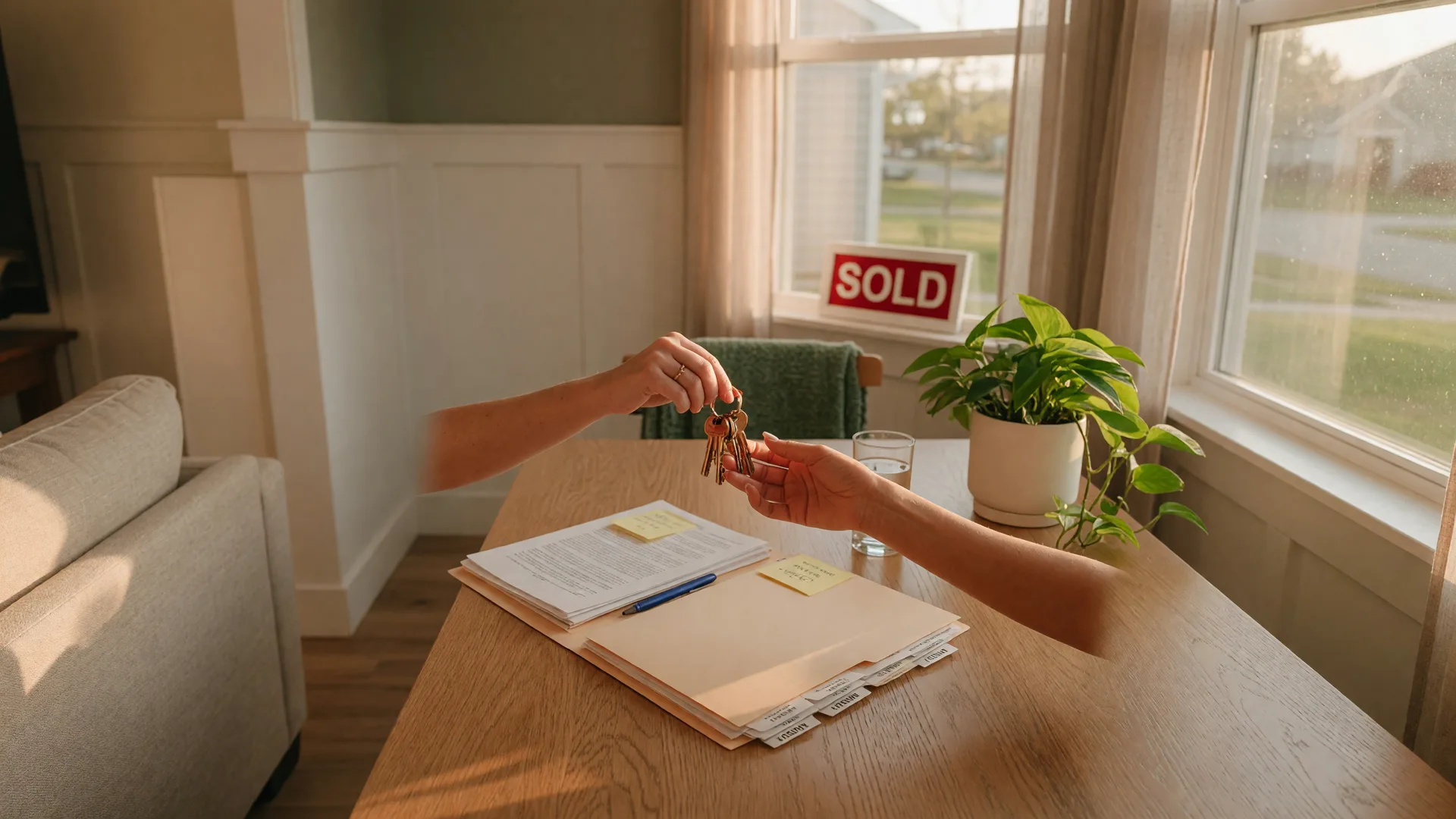
You will sign the mortgage note, the deed of trust or mortgage, the Closing Disclosure, the affidavit of title, and a stack of escrow and tax documents. The closing agent walks you through every page, your agent stays by your side, and the whole appointment usually takes about an hour. Once the funds transfer, the title company records the deed with the county, the seller gets their proceeds, and you get the keys. That moment, when it is officially yours, never gets old. I have walked through the fine print on all of this in my closing day walkthrough.
The 30 to 45 Day Timeline at a Glance
- Week 1: offer accepted, earnest money deposited, lender begins underwriting, inspection scheduled.
- Weeks 2 and 3: home inspection completed, repair negotiations, appraisal ordered and completed, title search underway.
- Week 4: loan conditions satisfied, title insurance cleared, Closing Disclosure issued and reviewed.
- Final days: final walkthrough, wire or cashier's check prepared, closing appointment, keys in hand.
For first-time buyers, the affordability side of this timeline matters too. Towns like Hammond offer the most accessible entry points in the region, often between $150,000 and $300,000, which keeps the earnest money and closing costs manageable. Munster buyers typically budget from about $334,000 to $372,000 for Blue Ribbon schools and the shortest Chicago commute. Wherever you land, the process is the same, and the complete buying guide keeps the whole journey in one place.
Mistakes to Avoid Between Offer and Closing
Most of the drama between acceptance and closing is avoidable. I have seen smart buyers trip on the same things, so here is the short list I give everyone before they sign:
- Do not take on new debt. One furniture purchase on credit can reset your approval days before closing. My rule has always been simple: do not buy anything until after closing.
- Do not change jobs or alter your income picture without telling your lender first, even for a better title.
- Do not move large sums between accounts without a clear paper trail.
- Do not skip the final walkthrough, and do not be shy about testing the home inside and out.
- Do keep paying bills on time and respond to lender requests the same day you get them.
The full journey from credit to closing is covered in my complete first-time home buyer guide, and if you are at the very beginning, start with the pre-approval guide so your offer is never a weak one. The National Association of Realtors also publishes buyer resources that confirm the value of working through this process with a licensed local agent.
Let's Get You to Closing Day With Confidence
You should feel excited about closing day, not anxious about it, and the way to get there is to know what is coming at every step. That is my job: I have got your back, and I want you to feel confident, not pressured, from our first conversation to the moment you get the keys. Whether you are just starting to save, pre-approved and touring homes, or sitting on an accepted offer in Crown Point, Schererville, or anywhere across Northwest Indiana, reach out for a free consultation or market analysis or call (219) 670-3704. Let's make your first closing a smooth one.
Related Reading
Complete First-Time Home Buyer Guide for Northwest Indiana
The whole journey from credit and pre-approval to choosing the right neighborhood, in one place.
Mortgage Pre-Approval in Northwest Indiana: A Buyer's Guide
How much you can afford, down payment options for 2026, and how to get your pre-approval letter.
Closing Costs in Northwest Indiana: What Buyers Actually Pay
A line-by-line breakdown of what to budget and how to save at the closing table.
Hammond, IN Neighborhood Guide
Affordable entry points, South Shore Line access, and why first-time buyers love Hammond.
Read the Buyer's Guide or contact Liz for a free market analysis.
Frequently Asked Questions
How long does it take from offer accepted to closing in Northwest Indiana?
In Northwest Indiana, the path from accepted offer to closing typically takes 30 to 45 days. The first week is the busiest: earnest money is deposited, the lender moves your file into underwriting, and the inspection is scheduled. Weeks two and three cover the inspection, the appraisal, and the title work. The final week brings the Closing Disclosure, the final walkthrough, and closing day itself. Some transactions close faster, some take a bit longer, but a 30 to 45 day window is what most buyers and sellers plan around here.
How much earnest money should a first-time buyer offer in Northwest Indiana?
The typical earnest money deposit in Northwest Indiana is 1% to 3% of the purchase price. On a $250,000 home, that is $2,500 to $7,500. Your deposit is held in escrow by a title company, not given to the seller, and it is credited toward your down payment or closing costs at closing. If the deal falls through because of a contingency in your contract, such as the inspection or the appraisal, you get your earnest money back. In a competitive situation, a stronger deposit can make your offer stand out, but it should never be money you cannot afford to have tied up.
What happens if the house appraises for less than my offer?
If the appraisal comes in below your offer price, you have a few options. The seller can lower the price to match the appraisal. You can make up the difference with a larger down payment. You can dispute the appraisal and ask the lender to reconsider with additional comps. Or, if you have an appraisal contingency in your contract, you can cancel and get your earnest money back. Most Northwest Indiana sellers would rather negotiate to keep a solid deal together than restart the entire process, so a low appraisal rarely ends the transaction if everyone talks it through.
When does the final walkthrough happen, and what should I check?
The final walkthrough usually happens 24 to 48 hours before closing. You are confirming the home is in the condition you agreed to buy: the negotiated repairs were completed, the sellers moved out, the home is clean, and the systems and appliances that were included are still there and working. Run the water, open the windows, check that lights and outlets work, and walk the whole property including the basement and the yard. It is your last chance to catch a problem while you still have leverage, so do not skip it.
What should I bring to closing day in Northwest Indiana?
Bring a valid government-issued photo ID, your cashier's check or proof of wire transfer for the remaining down payment and closing costs, and a copy of your purchase contract and Closing Disclosure. Personal checks are generally not accepted, and your closing agent will give you written wiring instructions ahead of time. Always confirm wiring instructions by phone using a number you know, since wire fraud is a real risk. Your agent and the closing agent walk you through every document, so bring questions too. The whole appointment usually takes about an hour, and you leave with the keys.